Written by Cari Borden
If you’ve spent any time in today’s workplace, you already know that the organizations that thrive aren’t just the ones with ping-pong tables, hybrid schedules, or some vague poster about “belonging.”
Inclusive cultures aren’t built by perks or policies; they’re built by people. And the people who build them well usually lean on a set of core, grounded behaviors that shape how they lead, how they learn, and how they show up.
So today, let’s strip away the buzzwords and go back to the fundamentals:
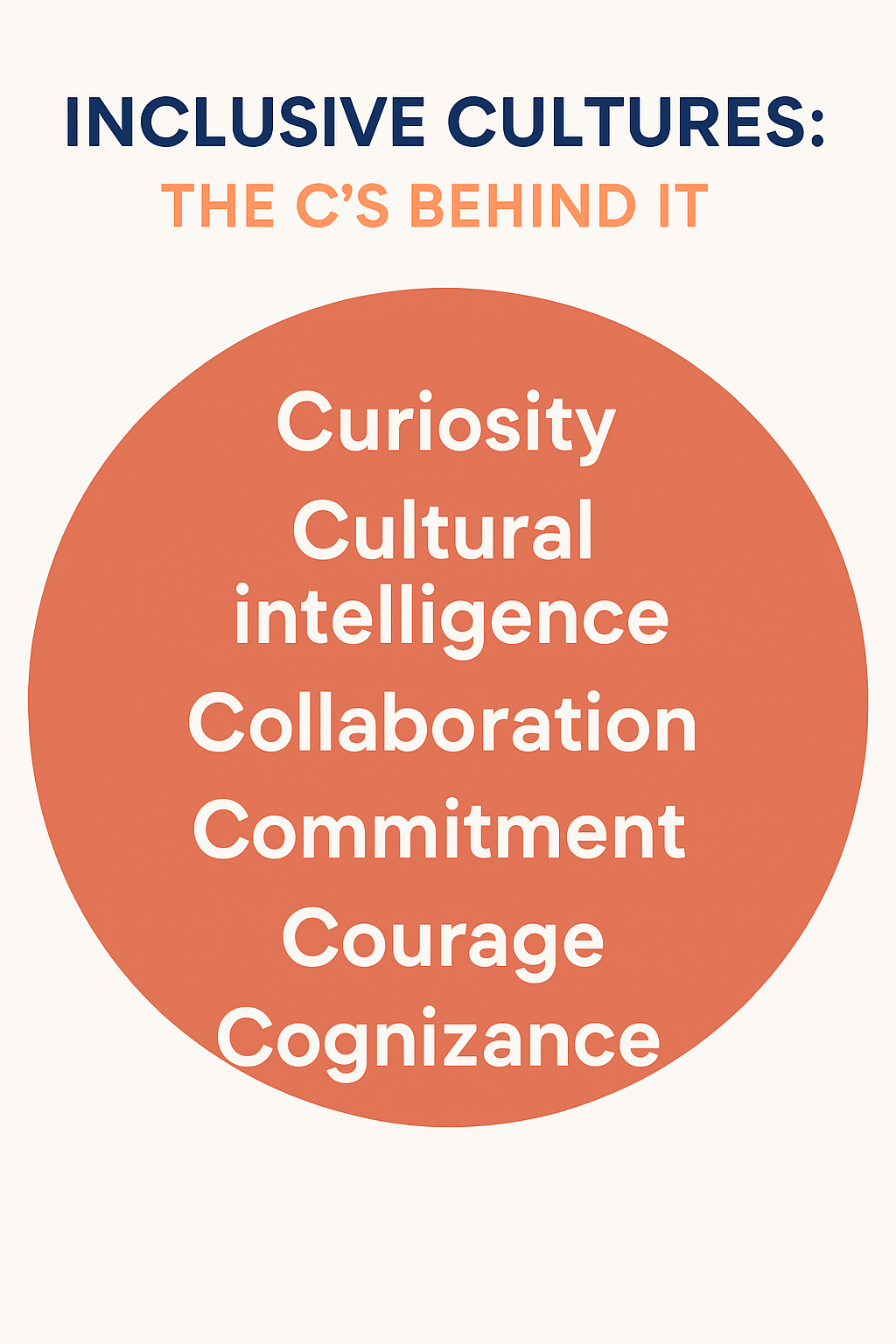
The Six C’s of an Inclusive Culture.
If you master these, you don’t just check the box you change the culture.
1. Curiosity — The Spark of Understanding
Inclusion begins with one simple act:
Being genuinely curious about people.
Curiosity isn’t interrogation. It’s not “Where are you really from?”
It’s the humble appetite to learn before assuming, to ask before judging, to listen before fixing.
Curiosity sounds like:
- “Tell me more about how you see it.”
- “What am I missing?”
- “How does this work for you?”
Teams built on curiosity turn differences into assets and conversations into connection.
2. Cultural Intelligence — The Skill of Navigating Differences
Cultural intelligence (CQ) is not trivia about holidays or etiquette.
It’s the ability to adapt, your mindset, your approach, your communication, based on the cultural context you’re in.
Leaders with high CQ notice the shifts: tone, pace, decision preference, hierarchy, directness, humor.
They don’t label differences as “wrong” or “difficult.”
They ask, “How do I adjust so we all succeed?”
It’s emotional intelligence with a global passport.
3. Collaboration — The Practice of Co-Creating
If curiosity is the spark, collaboration is the engine.
True collaboration doesn’t mean agreeing on everything.
It means creating an environment where everyone contributes without fear of being dismissed, overshadowed, or minimized.
Inclusive collaboration looks like:
- Shared decision-making
- Clear roles
- No “meeting monopolizers”
- Psychological safety baked into the workflow
- Celebrating collective wins instead of personal thrones
In inclusive cultures, the loudest voice isn’t the leader, it’s the team.
4. Commitment — The Consistency Behind the Culture
Commitment is where inclusion stops being a statement and becomes a standard.
This is the messy middle where leaders:
- Actually change processes
- Address inequities
- Rework hiring practices
- Empower new voices
- Stop excusing harmful behaviors as “just how he is”
Commitment shows up in the calendar, the payroll, the policies, and yes, the courage to say,
“We need to do better.”
5. Courage — The Backbone of Inclusion
There is no inclusive culture without courage.
Courage is calling out bias, in real time, even when it’s awkward.
Courage is speaking up for someone who hasn’t yet found their voice.
Courage is sitting in discomfort instead of rushing past it.
Courage doesn’t roar.
Sometimes courage whispers:
“I know better, so I’m going to do better.”
6. Cognizance — The Awareness That Keeps Us Honest
Cognizance is self-awareness with accountability.
It’s knowing your biases.
It’s noticing your patterns.
It’s catching your knee-jerk reactions before they land on someone else’s dignity.
Without cognizance, inclusion becomes performance.
With it, inclusion becomes practice.
Cognizance reminds us that inclusive cultures are not built from perfection, they’re built from intention.
Bringing the C’s Together
Inclusive cultures don’t magically appear because someone in HR wrote a value statement.
They grow when leaders, at every level, choose to live these C’s daily:
✨ Curiosity
✨ Cultural Intelligence
✨ Collaboration
✨ Commitment
✨ Courage
✨ Cognizance
These are not “initiatives.”
They are behaviors.
And behaviors, when modeled consistently, become culture.
Because workplaces don’t become inclusive through slogans.
They become inclusive through us.
 Lead With Your Heart
Leave a comment