Welcome to another episode of “Wellness? In this economy?”—where we dissect workplace wellbeing with a double shot of sarcasm and an oat-milk sprinkle of truth.
Today’s flavor? Emotional Intelligence—aka, the adulting skill leaders didn’t know they skipped.
🚩 “What’s Emotional Intelligence?”
If you’re asking this sincerely and you’re in a leadership role… sit down, we need to talk. Like, immediately.
Emotional Intelligence (EI) is that magical blend of:
- Self-awareness (Yes, you’re the common denominator in every conflict.)
- Self-regulation (AKA not rage-slamming your laptop because of a budget cut.)
- Motivation (Beyond caffeine and fear.)
- Empathy (Feeling with, not just for people.)
- Social skills (Can you talk to humans without HR involvement? Congrats!)
🤷♂️ “Wait… You Mean This Is a Skill?”
Yes. And like any skill, you either grow it—or you ghost it.
Here’s the thing: those who lack emotional intelligence rarely know they do.
They’re the ones confidently saying,
“I tell it like it is!” (Translation: I bulldoze emotions and call it leadership.)
“People are too sensitive these days.” (Translation: I don’t do nuance.)
“Why didn’t they just say something?” (Translation: My presence is so intimidating no one feels safe.)
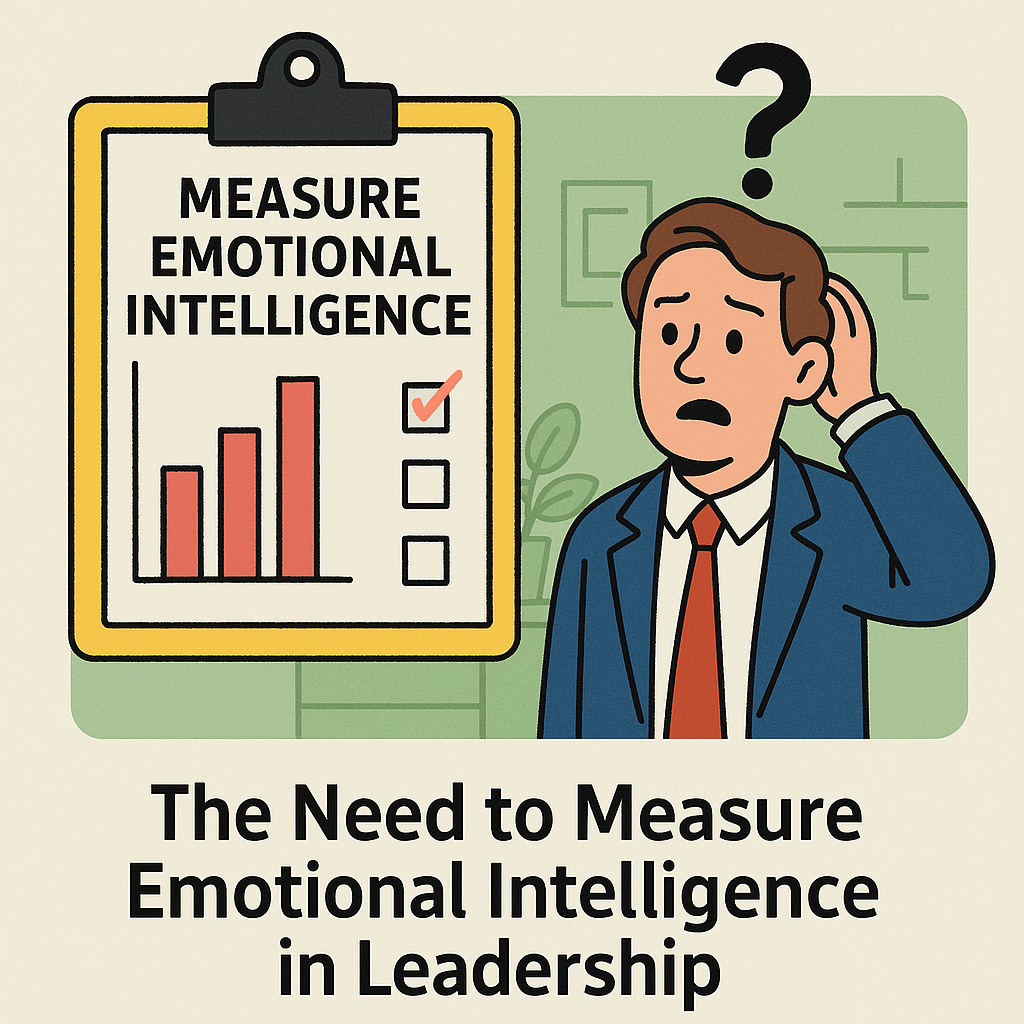
📏 Measuring Emotional Intelligence: No, It’s Not a Vibe Check
Let’s get practical. You can’t improve what you don’t assess—so here’s how organizations can stop guessing and start diagnosing:
- 360° Feedback Loops
Ask the people who experience the leader. If multiple folks say, “He’s great at strategy but doesn’t listen,” that’s not a coincidence—it’s a pattern. - Leadership EQ Assessments
Tools like EQ-i 2.0 or ESCI don’t lie. Unless, of course, the leader tries to game the test (and they will). Still, it’s a starting point. - Behavioral Observations
Watch meetings. Who dominates? Who deflects? Who actually makes people feel heard? Spoiler: It’s not the loudest one in the room. - Pulse Surveys
Ask direct questions like:
“Do you feel your leader understands your perspective?”
“Do you feel psychologically safe to disagree in meetings?”
Then… sit down and read the answers. Yes, even the ones that sting.
😵💫 But Why Bother?
Because here’s the plot twist:
Emotionally intelligent leaders build resilient, engaged, healthy teams.
Those who don’t?
Well… they keep HR real busy.
EI isn’t just fluffy “people person” stuff. It reduces burnout, builds trust, improves retention, and—bonus—makes people not dread Mondays.
🎯 Final Thought: If You Think This Doesn’t Apply to You…
It probably does.
If your reaction is “Ugh, people should just be more professional”, congratulations—you may be the emotional gap we’re talking about. 🥲
But there’s hope. You can grow this muscle. And your team? They’ll thank you with higher performance, fewer resignations, and maybe even eye contact during 1:1s.
 Lead With Your Heart
Leave a comment