Written by Cari Borden
You don’t usually notice trust when it’s there.
You notice it when you trip.
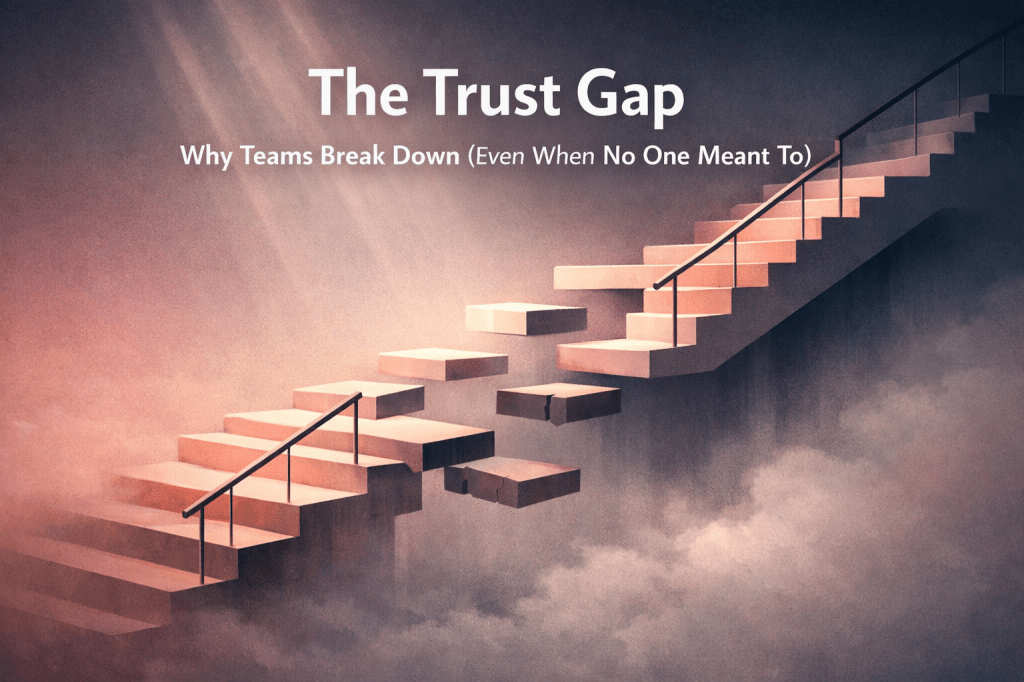
Think of your team like a staircase.
On the surface, it looks solid: job titles, org charts, meetings, tools, KPIs.
But trust? Trust is the architecture underneath, the hidden structure holding the whole thing up.
When trust is strong, people move easily, take risks, share ideas, own mistakes.
When trust is weak, it’s like walking up a staircase with missing steps.
Everyone looks like they’re moving forward… until someone’s foot lands where a step should be, and suddenly they’re hanging on by the railing, wondering what just happened.
Most teams don’t fall apart because people are evil or out to sabotage each other.
They fall apart because small gaps in trust never get repaired, they just keep getting stepped on.
This is the trust gap.
And it’s the quiet reason teams break down… even when no one meant to.
What Is the “Trust Gap,” Really?
The trust gap is the distance between what we say we value and what people actually experience.
- “We’re a transparent culture” vs. decisions made in closed rooms.
- “We support work–life balance” vs. praising people who answer emails at 10 p.m.
- “We’re one team” vs. leaders playing favorites.
From the outside, the staircase still looks intact:
nice values on the wall, polished town halls, quarterly engagement surveys.
But day-to-day, people feel the missing steps:
- Promises made, but never revisited.
- Feedback requested, but never acted on.
- Conflicts raised, but quietly ignored.
No one held a meeting and announced,
“We will now begin slowly eroding trust.”
It happens in tiny, almost invisible moments, the ones people feel in their gut but don’t always know how to name.
How Trust Quietly Erodes (Without Anyone “Being the Bad Guy”)
Here’s the hard truth:
You can have kind, well-intentioned, smart humans… and still have a low-trust team.
Trust doesn’t disappear because of one big betrayal (though that happens too).
More often, it slips away like this:
1. Micro-avoids instead of micro-actions
- A leader sees tension in a meeting and says nothing.
- A teammate notices someone being cut off and lets it slide.
- A broken process keeps causing issues, but “now’s not a good time” to fix it.
Each avoid is a missing step: small on its own, dangerous over time.
2. Inconsistent follow-through
People hear:
- “We’ll circle back on that.” (No one does.)
- “This will be our new priority.” (Until the next shiny thing.)
- “We’re going to fix this.” (Crickets.)
The message received isn’t, “We’re busy.”
It’s, “What you care about isn’t important enough.”
3. Unspoken power dynamics
Someone always gets deferred to.
Someone else always gets interrupted.
Someone’s ideas only land when a “higher title” repeats them.
No one says, “Your voice doesn’t matter.”
But the structure of the staircase says it for them.
4. “Nice” instead of honest
Conflict gets sugar-coated, delayed, or outsourced to HR.
Teams over-index on harmony and under-invest in clarity.
Trust doesn’t require everyone to be “nice.”
It requires people to be real, with respect.
5. Quiet exhaustion
When people are overworked, under-resourced, or constantly “on,” they don’t have capacity for generosity:
- They interpret neutral emails as hostile.
- They assume the worst instead of the best.
- They protect themselves instead of collaborating.
Burnout is not just a wellness issue.
It’s a trust issue.
How You Know Your Staircase Is Missing Steps
If any of these sound familiar, your trust architecture needs attention:
- The “after meeting” meeting.
The real conversation happens in DMs or hallway huddles after the call ends. - Idea hesitation.
People say, “This might be a stupid question…” far too often, or they stop speaking up at all. - Over-explaining and over-documenting.
Folks CC everyone, attach receipts, and add paragraphs of context because they don’t trust their work will be seen or believed. - Decision whiplash.
Priorities change fast, but rationale doesn’t get shared. People feel like pawns, not partners. - Emotional distance.
People do their tasks, hit their metrics… but they’re no longer emotionally invested.
None of these behaviors mean your team is doomed.
They mean your staircase is asking for repairs.
Trust Is Built in Behaviors, Not Slogans
You can’t “rebrand” your way into trust.
You build it (or rebuild it) through small, consistent, human actions.
Here’s where to start.
1. Name the missing steps
You can’t fix what you won’t name.
Try language like:
- “I’m noticing we say ‘we’re transparent,’ but people are hearing about decisions after they’re made. Let’s talk about that gap.”
- “We keep saying feedback is welcome, but I’m not sure it feels safe to give it. What would make it safer?”
You’re not attacking people.
You’re examining the staircase.
2. Make agreements, not assumptions
Trust grows when expectations are explicit and shared.
Instead of:
“Everyone should know how we work by now.”
Ask:
- “What does ‘urgent’ mean for this team?”
- “What’s our agreement on after-hours communication?”
- “How do we want to handle it when someone drops the ball?”
Write it down. Revisit it.
Agreements are the visible rails on an invisible staircase.
3. Follow through on small commitments
You don’t earn trust back with one big gesture.
You earn it with dozens of small, boring, dependable actions.
Examples:
- If you say, “I’ll send the notes,” send them that day.
- If you say, “Let’s revisit this next week,” put it on the calendar and actually revisit it.
- If you say, “I’ll look into this,” return with an update, even if the answer is, “I couldn’t fix it yet.”
Consistency is how you pour concrete into the missing steps.
4. Invite truth — and do not punish it
This is where trust either grows or dies.
When someone takes the risk to be honest, about workload, a broken process, or your own leadership, your first job is not to defend.
Your first job is to:
- Listen.
- Ask questions.
- Thank them for telling you.
- Share what you’ll do next (even if it’s small).
If people get punished for honesty, with retaliation, cold shoulders, or quiet sidelining, your staircase collapses. They won’t try again.
5. Repair, don’t just “move on”
When trust has been damaged, skipping the repair is like slapping a rug over a hole in the floor.
Instead, try:
- “I know I dropped the ball on this project. Here’s what I missed, here’s what I’m putting in place so it doesn’t happen again, and I’m sorry for the impact.”
- “We made a decision without looping in the people doing the work. That wasn’t okay. Here’s how we’re changing the process going forward.”
Repair doesn’t erase what happened.
It tells people: You matter enough for me to own my impact.
A Leader’s Role in the Trust Architecture
If you’re in any kind of leadership role, people leader, project lead, “unofficial glue” of the team, you are not just walking on the staircase.
You are part of how it’s built.
That doesn’t mean you’re responsible for everything that’s broken.
It does mean you have disproportionate power to:
- Set the tone for psychological safety.
- Model how to handle mistakes and hard conversations.
- Slow down long enough to see where people keep tripping and ask why.
Leadership isn’t about having all the answers.
It’s about being brave enough to say:
“Something here doesn’t feel right. Let’s fix the architecture, not just blame the people falling through it.”
Turning the Trust Gap into a Trust Practice
Trust isn’t a one-time initiative.
It’s a practice, built into how you meet, decide, communicate, and follow through.
If you want to begin closing the trust gap on your team, start with three questions:
- Where are people hesitating, whispering, or withdrawing?
That’s where the missing steps are. - Where do our words and actions not match?
That’s where your values need reinforcing with behavior, not branding. - What is one small promise I can keep this week?
Start there. Then keep another. Then another.
Because at the end of the day, people don’t stay for perfect leaders or flawless organizations.
They stay for staircases they can walk on without bracing for the fall.
They stay where trust isn’t just a word on the wall, it’s the architecture under their feet.
 Lead With Your Heart
Leave a comment