Written By Cari Borden
In a perfect world, HR is at the table early: designing roles, shaping culture, aligning people strategy with business goals, and preventing messes before they start.
In the real world?
HR gets the call when:
- Someone needs to be “talked to.”
- A leader has avoided a conflict for six months and now wants it “handled by HR.”
- There’s a complaint, a potential lawsuit, or a “situation.”
- The team is on the brink of mutiny and now we want to “do a morale thing.”
By the time HR walks into the room, the house is already on fire.
And then we act surprised that all they can do is triage.
This isn’t just annoying. It’s expensive, risky, and absolutely destructive to trust.
How HR Became the Corporate Cleanup Crew
Over time, many organizations have quietly trained people to see HR as:
- The disciplinarian
- The policy police
- The “paperwork people”
- The ones who show up when something has gone very, very wrong
Leaders wait until:
- Performance issues are years old
- Documentation is nonexistent
- Emotions are high
- Half the team has quietly checked out
And then they drop it all in HR’s lap with a cheery:
“Can you just fix this?”
Let’s flip the script:
HR is not the cleanup crew.
HR is risk management, culture design, talent strategy, and human sustainability.
If you only involve HR at the cleanup stage, you are misusing one of the most valuable functions in your business.
What HR Is Actually Designed to Do (When You Let Them)
Modern HR isn’t there to “pick up the pieces.” It’s meant to:
- Anticipate risk, not bandage it
- Design roles and org structures that make sense for the work and the humans doing it
- Build policies and practices that protect both people and the company
- Coach leaders before they blow up teams (or their own credibility)
- Use data to spot patterns—burnout, turnover, inequities—before they explode
Translation: HR should be more like a smoke detector and architect…
Not the person handed a mop after the ceiling collapses.
Six Fires That Start Long Before HR Gets the Call
Most HR “emergencies” didn’t start as emergencies. They started as tiny sparks nobody wanted to deal with.
Here are six of the most common:
1. Vague Expectations
No clear job descriptions. No defined success metrics. Just vibes and hope.
Result?
Confused employees, frustrated managers, and “performance issues” that are really just leadership issues.
2. Untouched Feedback
Employees have been dropping hints for months: in surveys, 1:1s, hallway comments, exit interviews.
Everyone nods…
And then nothing changes.
Result?
Quiet quitting, resentment, “mystery” turnover.
3. Promoting the Wrong People
The high performer gets promoted into leadership with zero training.
They know the work.
They don’t know how to lead humans.
Result?
Micromanagement, favoritism, panic coaching, and calls to HR that begin with:
“My team is so sensitive…”
4. Weaponized “Urgency”
Everything is urgent, nothing is planned, and “we don’t have time for people stuff” becomes the unofficial motto.
Result?
Burnout, errors, conflict, and eventually… HR being asked why everyone is leaving.
5. Avoided Conversations
Tension is obvious. Performance is slipping. Behavior is off.
Everyone sees it. No one addresses it.
Result?
By the time HR is called, emotions are high, trust is low, and every conversation is now “HR-level serious.”
6. Shady or Sloppy Decisions
Off-the-record side deals. Inconsistency in how policies are applied. Leaders doing “just this once” exceptions to get things done.
Result?
Perceived unfairness, actual inequity, or legal exposure.
And then HR is called to “clean up the confusion.”
None of these ignited overnight.
They smoldered.
They cracked the foundation.
And HR was invited in once the smoke was visible from space.
Dear Leaders: Call HR Before the Fire, Not After
If you’re a leader, here’s how to stop treating HR like the cleanup crew and start using them like strategic partners.
1. Bring HR in When You’re Planning, Not Panicking
- New team structure? Call HR.
- New role or promotion? Call HR.
- Big change coming? Call HR before you announce anything.
Early HR involvement = better design, fewer messes, less drama.
2. Ask for Help Building Your Leadership Muscles
Instead of:
“Can you write me a warning?”
Try:
“Here’s what I’m noticing. Can you help me coach this person and set expectations early?”
HR can help you:
- Frame the conversation
- Document appropriately (before it’s dire)
- Support you in being clear, fair, and consistent
3. Treat HR as Your Reality Check, Not Your Alibi
HR is not there to rubber-stamp bad decisions.
Use HR for:
- Gut-checking big people decisions
- Asking, “Does this align with our values and policies?”
- Surfacing patterns you may be too close to see
4. Share the Tough Stuff Before It’s Explosive
If you know there’s:
- A personality clash brewing
- A change that will upset people
- A pattern of complaints about the same issue
Loop HR in early and honestly.
They can’t support what they don’t know about.
Dear HR: You’re Not a Mop — You’re a Strategy Function
Now, if you are in HR, People & Culture, or Talent… some tough love:
You teach boundaries. You also need them.
Here’s how to start stepping out of cleanup mode and into strategic mode.
1. Stop Saying “We’ll Handle It” When You Mean “We’ll Support You”
Swap this:
“I’ll take care of it.”
For this:
“I’ll support you in addressing this as the leader. Let’s walk through the next steps together.”
You’re not removing responsibility.
You’re building capability.
2. Name the Pattern, Not Just the Incident
When you’re brought in late, say it:
“What I’m seeing is a pattern that started months ago. Next time, let’s involve HR at the planning stage so we can prevent this from getting to crisis level.”
You’re not blaming.
You’re educating.
3. Draw a Line Between HR’s Role and Leadership’s Role
Examples:
- HR’s role: Provide guidance, policy, process, training, and risk awareness
- Leader’s role: Have the hard conversations, set expectations, follow through, own the decision
Say it out loud in meetings. Often.
4. Track the Cost of “Cleanup-Only” HR
When you can, show:
- Turnover tied to avoidable issues
- Legal or compliance risks from late involvement
- Productivity loss from conflict that simmered too long
Data gives you leverage to say:
“This isn’t just an HR complaint. This is a business risk.”
The Trust Problem No One Wants to Admit
When HR only shows up for:
- Investigations
- Disciplinary conversations
- Terminations
Employees associate HR with fear, not support.
Leaders subconsciously see HR as:
- The “bad news” messenger
- The closer of doors
- The fixer of messes
And then everyone wonders why:
- Employees don’t feel safe going to HR
- Leaders hesitate to involve HR until they’re desperate
- HR feels burned out and undervalued
Trust erodes because HR is visible only in crisis.
The solution?
Make HR visible in:
- Onboarding experiences
- Career development conversations
- Leadership training
- Culture-building initiatives
- Everyday decision-making
HR shouldn’t be the final chapter.
They should be co-authors from page one.
So… Now What?
If you’re a leader, ask yourself:
- Do I only think of HR when something has gone wrong?
- Where could I invite HR in earlier — structuring my team, designing roles, planning change?
- Am I asking HR to clean up what I’m avoiding addressing?
If you’re in HR, ask yourself:
- Where am I acting like the cleanup crew instead of setting expectations early?
- How can I reframe my language to coach leaders instead of rescuing them?
- What data do I have that shows the cost of waiting too long?
And if you’re both exhausted and a little fired up right now?
Good. That means this landed where it needed to.
Final Thought: HR Is Not Your Fire Department. It’s Part of Your Blueprint.
You don’t build a house and then later ask:
“Hey, do we need wiring? Plumbing? A foundation?”
Yet that’s how many organizations treat HR.
They build the org.
Skip the people strategy.
Ignore the smoke.
Then panic-call HR when the fire is already in progress.
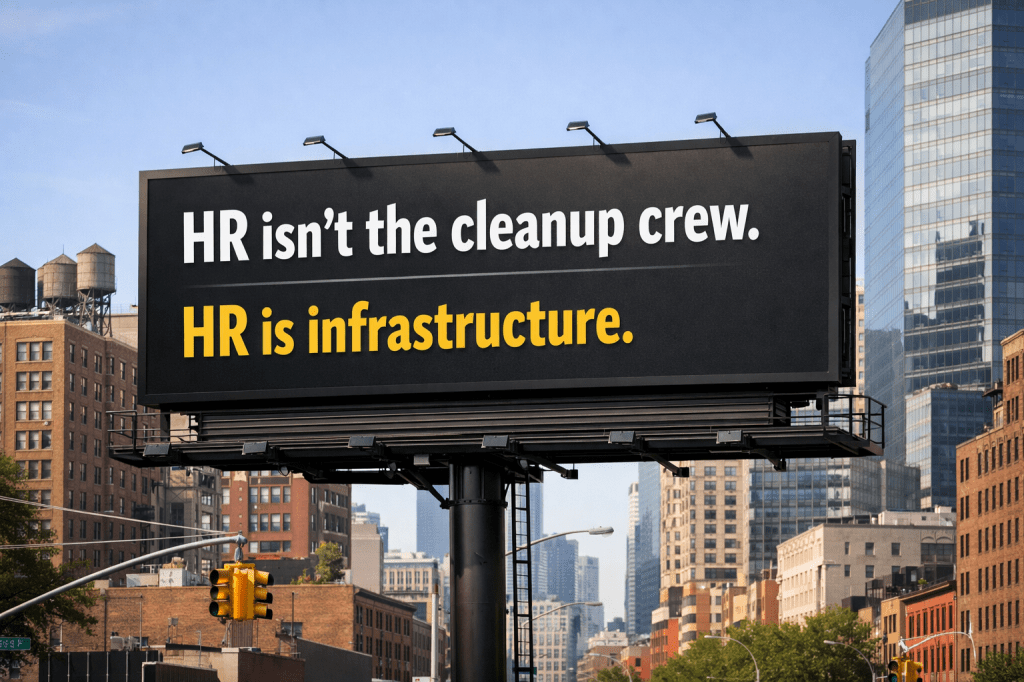
HR isn’t the cleanup crew.
HR is infrastructure.
Invite them in when you’re drawing the blueprint —
not when you’re already standing in the ashes, wondering what went wrong.
 Lead With Your Heart
Leave a comment