Written By Cari Borden
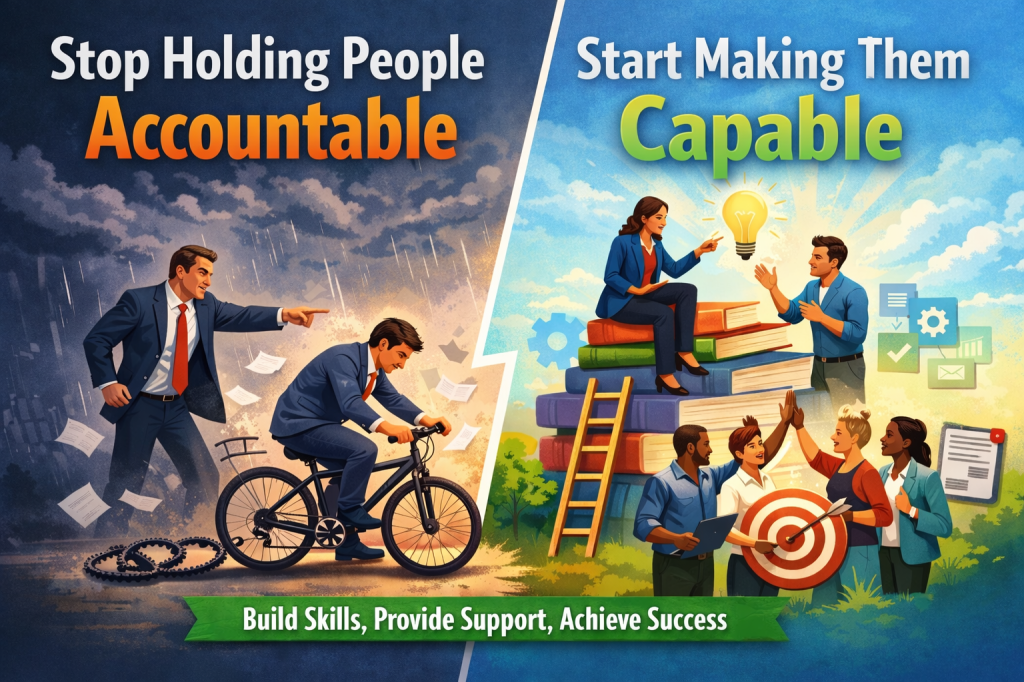
Because “Did you coach them?” is not the same as “Did you set them up to win?”
We toss around accountability like confetti in corporate life.
“Let’s hold them accountable.”
“We need an accountability culture.”
“Who’s accountable for this?”
Cool. But here’s the question nobody asks:
Are they actually capable of doing what you’re holding them accountable for?
If not, you’re not building an accountable culture.
You’re building a blame culture, with really nice slide decks.
This blog is your gentle-but-direct reminder:
Stop obsessing over accountability first.
Start obsessing over capability.
Accountability Without Capability Is Just Dressed-Up Punishment
Accountability is important. This isn’t a “let people do whatever they want” post.
But here’s the pattern I see over and over:
- Leaders set vague or unrealistic expectations.
- Training (if it exists) is rushed, generic, or completely misaligned.
- Systems are clunky. Tools don’t talk to each other. Processes are tribal knowledge.
- Employees struggle. Mistakes happen.
- Leadership: “We need to hold people accountable.”
Translation:
“We skipped the hard work up front. Let’s skip straight to consequences.”
Accountability without capability is like handing someone a bike with no chain and yelling at them to pedal harder.
They don’t need more pressure.
They need a chain.
Capability: The Part of Performance We Pretend Is “Optional”
If you want performance, you need more than rules and repercussions. You need this equation:
Clear Expectations + Skills + Resources + Support + Psychological Safety = Capability
Break that down:
- Clear Expectations
- Do they actually know what “good” looks like?
- Have you shown examples, not just given them a job description?
- Skills
- Have they had time to practice, not just attend a 60-minute webinar?
- Did anyone observe them and give feedback, or did we just check a training box?
- Resources & Tools
- Do the systems actually work… or do they have 17 logins and a sticky note forest?
- Are they missing job aids, templates, or reference materials?
- Support & Coaching
- Do they have someone they can go to when they’re stuck?
- Or is the culture: “Figure it out, but also don’t mess up”?
- Psychological Safety
- Can they say, “I don’t know,” without being labeled difficult, lazy, or “not a good fit”?
- Or do they fake it until they break it?
If any of these are missing, you don’t have a performance problem.
You have a capability gap.
Before You “Hold Them Accountable”… Ask This
Here’s a simple leadership rule:
You don’t get to hold someone accountable for what you never made possible.
Before you jump to “they’re not stepping up,” walk through this checklist:
- Did I define success clearly?
- Could they explain the goal in their own words?
- Did I provide examples, standards, or benchmarks?
- Did I give real training or just information?
- Did they get to try, practice, and get feedback?
- Or did I firehose them with content and call it “onboarding”?
- Did I remove barriers?
- Are processes outdated or contradictory?
- Are they waiting on approvals, access, or unclear handoffs?
- Did I make it safe to ask questions?
- Do I react with curiosity or with frustration?
- Do people hide mistakes because they know what happens when they’re honest?
- Did I follow up like a leader, not a hall monitor?
- Did I check in before the deadline or only after there was a problem?
- Did I coach or just collect status updates?
If you can’t check these boxes with a straight face, accountability is premature.
You’re trying to harvest where you never planted.
L&D & HR: This Is Where You Shine
If you’re in HR, Talent, or Learning & Development, this is your sweet spot.
You’re not just “the training people.”
You’re the capability architects.
Here’s how you shift the conversation:
1. Move from “Training Requests” to Performance Consulting
When a leader says, “We need training,” ask:
- What are people doing now?
- What does “good” look like?
- What gets in the way?
- What tools, time, or support are missing?
Sometimes the answer is training.
Sometimes the answer is: “Your process is a maze and your metrics are chaos.”
2. Design for Application, Not Attendance
Stop measuring success by “butts in seats” or “modules completed.”
Design experiences that:
- Include realistic scenarios from your actual workplace
- Build skills with practice, not just slides
- Integrate with coaching, huddles, and manager follow-up
- Provide tools people can use on the job tomorrow
If they leave your training with clarity, confidence, and a checklist they actually use, you’re building capability, not just compliance.
3. Make Capability Visible in Your Metrics
Connect your work to outcomes:
- Error rates
- Customer satisfaction
- Time to proficiency
- First-contact resolution
- Turnover or promotion rates
When leaders see that capability investments move real numbers, “hold them accountable” slowly shifts to “how do we better support them?”
For Leaders: How to Make People Capable (Not Just Afraid)
If you lead a team, here’s your new playbook.
1. Start With “What Did We Miss?”
When something goes wrong, ask:
- Where did we make this confusing?
- What did we skip in training or communication?
- Did we assume they knew something they had no way of knowing?
This doesn’t let people off the hook.
It just puts your leadership on the hook too, where it belongs.
2. Show, Don’t Just Tell
If you want a higher standard, demonstrate it.
- Walk them through what “great” looks like.
- Use side-by-side examples: “This is acceptable. This is excellent. Here’s why.”
- Don’t just say “be proactive”, define what proactive looks like in their role.
3. Build Capability Into Everyday Work
You don’t need a 3-day retreat.
You need rhythm:
- Short, focused coaching sessions
- Shadowing and reverse shadowing
- Peer learning (let the strongest in a skill teach others)
- Quick debriefs after projects: “What did we learn? What do we try next?”
4. Then — and Only Then — Use Accountability Like an Adult
Once you’ve:
- Set clear expectations
- Built capability
- Removed barriers
- Offered support
…then accountability becomes fair and necessary.
That’s when conversations sound like:
“We’ve trained on this, we’ve practiced it together, and the expectations are clear. Help me understand what’s getting in the way of you doing this consistently.”
Consequences make sense after you’ve invested in capability.
Before that, they’re just punishment with a performance label.
A Quick Capability Check You Can Use This Week
Pick one person or project that’s struggling and walk through this mini-audit:
- What exactly are they supposed to be doing?
- Have I shown them what “great” looks like?
- Do they have the skills? How do I know?
- What barriers are in their way that are in my control to remove?
- Have I created a space where they can admit confusion or ask for help?
- What’s one thing I can do this week to make them more capable?
Do that consistently, and here’s what happens:
- Performance improves.
- Trust grows.
- People stop bracing for blame and start reaching for better.
That’s not just accountability.
That’s leadership.
Final Thought: Capability First, Accountability Always — In That Order
Accountability isn’t the villain.
But it’s not the starting point.
If you want a culture where people own their work, take pride in it, and step up?
You have to give them something solid to step onto.
Stop leading with:
“How do we hold them accountable?”
Start leading with:
“How do we make them capable — and then honor that capability with clear, fair accountability?”
That’s where performance lives.
That’s where trust grows.
And that’s where people don’t just survive work — they actually shine.
 Lead With Your Heart
Leave a comment