
A Survival Guide for Today’s Workplace Written by Cari Borden
You’ve probably felt it before.
A new policy drops.
A reorg gets announced.
Someone quietly disappears from the org chart.
And in the back of your mind, the question shows up:
“Am I one bad decision away from an adverse impact in my career?”
In today’s workplace, it’s not a dramatic question.
It’s a realistic one.
Because one uninformed “strategic” decision can:
- Derail a career
- Disproportionately impact certain groups
- Destroy psychological safety on a team
- Expose the organization to legal and reputational risk
The catch? Most of these decisions were never intended to be harmful. They were meant to be efficient. Strategic. Fast. “Business-first.”
This blog is here to do two things:
- Name what’s happening — especially where DEI, psychological safety, and fairness are being compromised.
- Act as a survival guide — for the people living with the fallout of decisions they didn’t make, but are forced to feel.
The High-Stakes Reality: One Decision Can Shift Everything
In modern organizations, “risk” doesn’t just live in finance, operations, or technology anymore.
Risk is now deeply human.
- A hiring shortcut that screens out certain people more than others
- A “neutral” policy that lands very differently depending on gender, race, age, or caregiver status
- A restructuring that looks efficient on a slide but doubles the workload of one group
- A “speak up” initiative that punishes the first person who actually speaks up
In HR terms, one decision can lead to:
- Adverse impact – when a policy or practice disproportionately harms members of a protected group, even if it wasn’t intentional
- Loss of psychological safety – people no longer feel it’s safe to ask questions, raise concerns, or share ideas
- Perceived unfairness – inconsistent consequences, favoritism, moving goalposts
- Culture erosion – people stop trusting leadership and start quietly checking out
No memo says, “We’re about to break trust and increase our legal risk.”
But that’s exactly what happens when decisions are made without the right lenses.
When “Strategic” Decisions Fail: The Knowledge Gap
Most leaders are not waking up thinking, “How can I cause harm today?”
The problem is almost always a knowledge gap, not pure intent.
Here’s what that looks like in real life.
1. The DEI Blind Spot
Leadership decides to “tighten up” promotion criteria.
On paper it sounds reasonable:
- Must have X tenure
- Must have Y performance rating
- Must be in Z location
No one runs an adverse impact analysis.
No one checks who actually has access to the opportunities that lead to that performance rating.
No one reviews whether certain groups have systematically been left out of stretch assignments.
Result?
Entire demographics are effectively blocked from advancement, and the company just quietly created a barrier disguised as “standards.”
2. The Psychological Safety Misfire
A company launches a “speak up culture” campaign.
There are posters. Emails. A town hall. A branded inbox for feedback.
An employee takes it seriously and raises a difficult concern about workload, leadership behavior, or bias on the team.
Instead of being protected, they’re suddenly:
- Left out of meetings
- Getting cooler performance feedback
- Labeled as “negative” or “not a team player”
Result?
Everyone else learns the lesson:
“Speak up” is marketing. Silence is survival.
3. The “Efficiency” Trap
To “streamline,” leadership decides to consolidate roles.
Workload is redistributed to the most capable and reliable people because “they can handle it.”
On paper, it looks like good utilization.
In practice:
- The same people are always carrying more than their share.
- Burnout increases.
- High performers become flight risks.
Result?
The organization gets short-term coverage and long-term instability.
In all three cases, the decisions were framed as strategic, faster, leaner, more efficient.
But without:
- DEI analysis
- Psychological safety checks
- Fairness and impact review
- Actual input from the people affected
…strategy becomes guesswork. And guesswork, at scale, becomes harm.
What It Feels Like to Work Under Unpredictable Decisions
For employees, this isn’t theoretical.
It feels like:
- Wondering if a single restructure will erase the role you’ve worked years to build.
- Questioning whether your identity, age, or life circumstances make you more expendable.
- Feeling unsafe to ask basic questions about a change because it might label you as resistant.
- Watching others quietly harmed by a policy, and realizing there’s no safe channel to name it.
This is where psychological safety and DEI aren’t buzzwords.
They’re the difference between:
- Being able to plan a career
- And constantly bracing for impact
So yes, in some workplaces, it really does feel like you’re one decision away from fallout.
The good news? You’re not powerless.
You can’t control the decisions, but you can control how prepared you are for them.
That’s where the survival guide comes in.
Survival Guide: How to Protect Yourself When Leadership Decisions Go Sideways
You shouldn’t have to survive your job, but many people do.
The goal here isn’t to make you paranoid.
It’s to make you prepared, observant, and informed, so you can respond from a place of power instead of panic.
1. Document Early, Often, and Neutrally
Documentation is not about “building a case” against anyone.
It’s about:
- Creating a clear record of expectations
- Tracking changes in responsibilities
- Capturing feedback, outcomes, and timelines
Document:
- New responsibilities assigned and when
- Any major changes to role, schedule, or metrics
- Key conversations that affect your work or performance
Use calm, factual language.
If things ever feel unfair, you’ll have more than just a feeling, you’ll have a timeline.
2. Know the Policies Better Than Anyone
Policy isn’t just something HR cares about.
It’s often your safety net.
Familiarize yourself with:
- Anti-discrimination and anti-harassment policies
- Performance management and corrective action processes
- Promotion, transfer, and internal posting policies
- Accommodation and leave policies
When you understand the rules:
- You can better spot when they’re being bent or broken.
- You can ask more precise, empowered questions when decisions affect you.
3. Build Allies, Not Just Audiences
Venting feels good in the moment, but it doesn’t always protect you.
Focus on building:
- Trusted peers who see what you see
- Leaders who have demonstrated fairness and integrity
- HR contacts you can speak to confidentially
You don’t need everyone on your side.
You need a few people who will:
- Validate what you’re experiencing
- Help you see options
- Stand with you if you raise concerns
4. Ask Clarifying Questions (They Save Careers)
When a decision drops, it’s tempting to freeze, fume, or assume.
Instead, try questions like:
- “What is the goal behind this change?”
- “How will success be measured?”
- “What support will be provided during this transition?”
- “How will this decision be applied consistently across the team?”
- “How does this align with our DEI and psychological safety commitments?”
You’re not challenging the decision; you’re clarifying its intent and impact.
Sometimes leadership hasn’t fully thought it through.
Your questions can be the mirror they didn’t realize they needed.
5. Watch for Patterns, Not Just One-Offs
One uncomfortable decision is concerning.
A pattern of them is a warning sign.
Pay attention to questions like:
- Who is always most impacted by changes?
- Who gets grace and who gets scrutiny?
- Who gets pulled into decisions and who is kept in the dark?
When you see patterns, you can:
- Decide whether this environment can realistically be changed
- Consider internal moves to healthier teams
- Start preparing for an external move if needed
You’re not “overreacting.” You’re reading the data in front of you.
6. Know When to Use Your Voice — and When to Use the Exit
Your voice matters. And sometimes, the bravest thing you can do is:
- Provide constructive feedback
- Use formal channels to report unfair treatment
- Offer alternatives that protect both people and performance
But it’s also true that some environments are not ready to change, or willing to.
If you’ve:
- Raised concerns respectfully
- Used the channels available
- Tried to influence from where you are
…and the pattern continues, it may be time to shift the question from:
“How do I survive this?”
to
“Where can I thrive instead?”
For Leaders: Your “Small” Decisions Are Not Small
If you’re a leader or HR professional reading this, here’s the hard truth:
You are never making a small decision when it impacts people.
Every decision runs through a silent checklist in your employees’ minds:
- “Can I trust you?”
- “Do you see me?”
- “Am I safe here?”
- “Does this align with what you say we value?”
Before you finalize a decision that affects people, ask:
- DEI Lens:
- Who is most affected by this?
- Have we run an adverse impact analysis?
- Are certain groups being unintentionally disadvantaged?
- Psychological Safety Lens:
- Will this make people more afraid to speak up or less?
- Are we modeling transparency, or will this feel like a surprise ambush?
- Fairness Lens:
- Is this being applied consistently?
- Does it align with how similar situations were handled before?
- Communication Lens:
- Are we telling people why we’re doing this, not just what we’re doing?
- Are we making space for questions without retaliation?
Leaders don’t need to be perfect.
But they do need to be teachable, transparent, and willing to course-correct.
One of the most powerful things a leader can say is:
“We missed something in this decision. Here’s how we’re fixing it.”
That’s not weakness. That’s leadership.
You’re Not Just One Decision Away From Adverse Impact — You’re One Prepared Step Away From Regaining Control
The truth is, yes, one decision can shift your work life in uncomfortable ways.
But you are not helpless.
You can:
- Understand your rights and your policies
- Build documentation and allies
- Ask better, braver questions
- Name patterns instead of doubting your instincts
- Choose whether to stay and influence, or go and rebuild elsewhere
And if you’re a leader?
You can decide that no strategic decision is successful if it harms the very people you rely on to execute it.
Because in the end:
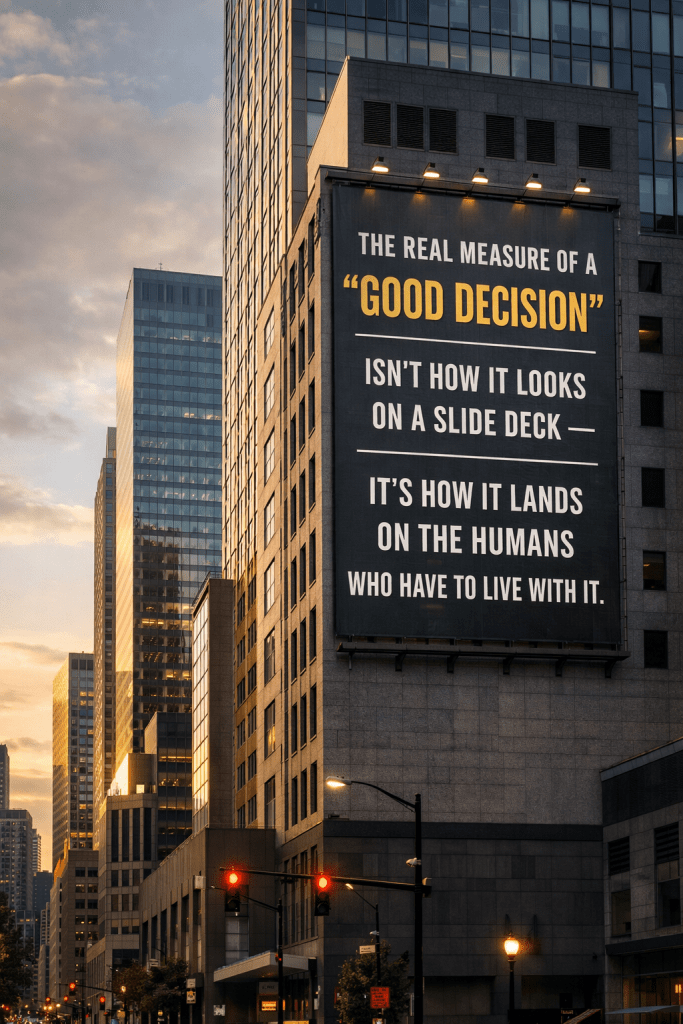
The real measure of a “good decision” isn’t how it looks on a slide deck —
it’s how it lands on the humans who have to live with it.
 Lead With Your Heart
Leave a comment