Written by Cari Borden
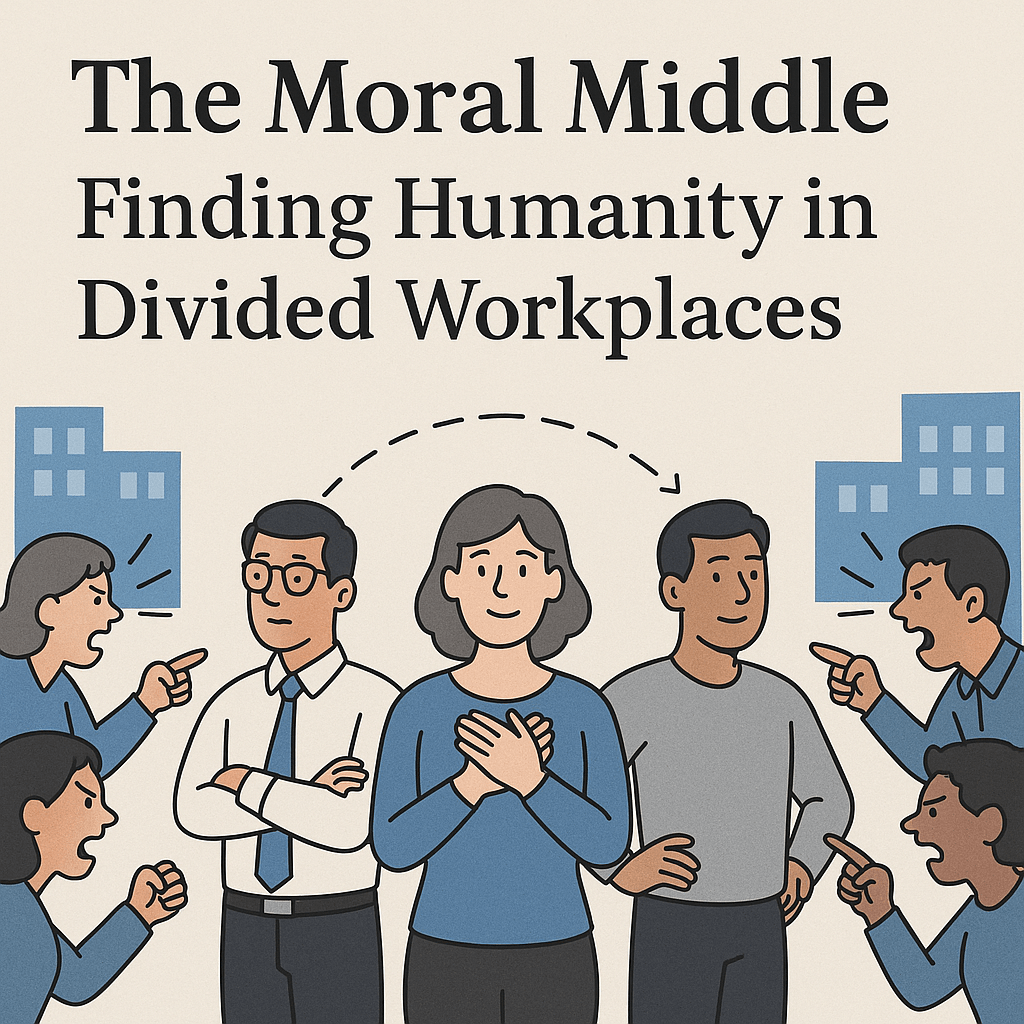
You know that feeling when two sides are at war in your workplace, and you’re… the human buffer between them?
Leadership vs frontline. Old guard vs new hires. “Back-to-the-office” crusaders vs “my laptop, my rules” remote die-hards.
Welcome to the moral middle, where your values are strong, your empathy is high, and somehow, you’re always the one trying to keep the peace while also keeping your sanity.
This blog is your go-to guide for that exact space.
What Is the “Moral Middle” (and What It Definitely Isn’t)?
Being in the moral middle does not mean:
- You’re neutral about everything.
- You’re spineless, indecisive, or “too nice.”
- You agree with everyone so no one gets upset.
The moral middle does mean:
- You know what you stand for, but you don’t weaponize it.
- You’re willing to stay in hard conversations without burning people down.
- You care about the humans more than the headlines, factions, or office politics.
Think of it as this:
You’re not trying to “win” the argument.
You’re trying to keep everyone’s humanity intact, including your own.
Step 1: Check Your Own Compass Before You “Mediate”
Before you walk into any divided situation as the “middle” person, start with you.
Ask yourself:
- What do I actually believe about this situation?
- Where do my values feel pushed or violated?
- Where am I reacting out of fear, people-pleasing, or wanting to be liked?
- What outcome would let me sleep at night, even if no one thanks me?
Write it down if you need to. Moral clarity doesn’t mean you’ve got it all figured out; it just means you’re honest with yourself before you step into the storm.
Because here’s the truth:
If you don’t know what you stand for, the loudest voice in the room will gladly decide for you.
Step 2: Decode the Drama
What are we actually fighting about?
Most workplace “division” isn’t just about the surface topic. It’s usually about one (or more) of three things:
- Identity:
- “Do I still matter here?”
- “Am I being replaced, ignored, or erased?”
- Safety:
- “Am I going to lose my job?”
- “Is my reputation at risk if I speak up?”
- Fairness:
- “Why are some people allowed to do X while we’re told to do Y?”
- “Why does that group always seem to win?”
When you’re in the middle, your quiet superpower is noticing what’s underneath the fight.
You don’t have to say,
“I think this is about your fear of becoming irrelevant, Bob.”
But you can say:
- “It sounds like you’re worried about being left out of decisions.”
- “I’m hearing frustration around fairness and consistency, am I getting that right?”
You’re not fixing it. You’re naming it. And naming things lowers the emotional temperature.
Step 3: Language for the Middle
Phrases that keep things human, not hostile
When the room gets tense and people go into battle mode, your words can either escalate or soften the moment.
Here are some “moral middle” phrases you can keep in your back pocket:
To slow things down:
- “Can we pause for a second? I want to make sure I’m really understanding.”
- “Before we go further, can we clarify the actual decision that needs to be made?”
To show you’re listening (without agreeing):
- “I can see this matters a lot to you.”
- “I may not share the same view, but I do want to understand how you’re seeing it.”
To call people back to humanity:
- “Can we talk about this as teammates instead of sides?”
- “I don’t want us to lose respect for each other over this. How do we keep this constructive?”
To gently push on unhelpful behavior:
- “I’m hearing a lot of heat and not a lot of solutions yet. Can we try again, but this time focus on what we want instead of what we hate?”
- “I’m not comfortable with personal attacks. Can we go back to the issue, not the person?”
You don’t have to sound like a TED Talk. You just have to interrupt the spiral.
Step 4: Boundaries Are Not Betrayal
Being “in the middle” does not mean you absorb everyone’s anger, fix every conflict, and sacrifice your mental health as tribute.
You’re allowed to have boundaries like:
- “I’m willing to listen, but I’m not willing to gossip.”
- “I care about what you’re feeling, but I can’t stay in a conversation that keeps attacking people who aren’t in the room.”
- “I’m happy to help brainstorm solutions, but I can’t be the messenger for things you’re not willing to say yourself.”
Boundaries are not you abandoning the middle.
They’re you protecting the space so the middle doesn’t turn into a dumping ground.
Step 5: Build Micro-Bridges (Not Grand Gestures That Get You Fired)
You’re not here to orchestrate a company-wide reconciliation retreat with candles and trust falls. (Unless you’re paid for that. Then shine.)
Most of your influence will show up in micro-bridges, small, everyday behaviors that move people 1% closer to each other:
- Use “and,” not “but.”
- “I hear that this change is hard and I’m also hearing how important it is for the business.”
- Name shared goals.
- “It sounds like we all care about protecting our clients and keeping our jobs secure. We just have wildly different ideas about how.”
- Humanize the ‘other side.’
- “Just for context, here’s what leadership is worried about.”
- “Here’s what the frontline is experiencing that maybe hasn’t been visible.”
- Invite curiosity.
- “Can we do one round where each person only asks questions, not defends their position?”
You’re not forcing agreement. You’re making it harder to dehumanize each other.
Step 6: When You Need Receipts
Documenting without becoming “the problem”
Let’s be honest: divided workplaces can go from uncomfortable to unsafe.
If you’re consistently witnessing:
- Harassment, discrimination, or retaliation
- Ethical lines being crossed
- People being punished for raising legitimate concerns
You’re no longer just “stuck in the middle.” You’re in a situation where documentation matters.
You can:
- Keep a factual log: dates, times, what was said/done, who was present.
- Save emails/slack messages that show patterns (not to weaponize, just to protect yourself if needed).
- Use neutral, non-emotional language when you do raise concerns:
- “On [date], during [meeting], [behavior] occurred. This is the impact I’m seeing on the team.”
You’re not being dramatic. You’re being responsible.
The moral middle doesn’t mean moral silence.
Step 7: Red Flags—When the Middle Is No Longer Safe
Sometimes the bravest thing you can do from the middle… is walk out of it.
You may need to reconsider staying if:
- You’re being asked to lie, cover up, or manipulate others.
- You feel physically unsafe, emotionally abused, or constantly threatened.
- Your values and the organization’s actions are in open warfare.
- You’re doing unpaid emotional labor as the permanent “conflict therapist,” with zero support or authority.
If you’re here:
- Document.
- Seek HR, if it’s safe.
- Talk to a trusted mentor, therapist, or coach.
- Start quietly exploring other options.
Leaving doesn’t make you weak or disloyal.
It means your integrity and well-being are not up for negotiation.
If You’re a Leader Reading This…
First of all: thank you for not closing the tab.
If you notice people on your team living in the moral middle:
- Protect them. They’re often the ones absorbing pressure from both sides.
- Empower them. Give them language, structure, and backup when they help mediate.
- Don’t exploit them. “You’re so good with people” is not an excuse to outsource all conflict handling to them.
Ask yourself:
- “Am I rewarding the loudest voices, or the wisest?”
- “Am I making it safe for people to disagree without being punished?”
- “What am I modeling when I’m the most stressed or triggered?”
The health of the middle says a lot about the health of the culture.
How to Use This Guide When You’re Stuck in the Middle (Quick Checklist)
When the next divided situation hits, you can:
- Pause and check your own values.
- Ask yourself what the fight is really about (identity, safety, fairness).
- Use de-escalating language instead of jumping onto a side.
- Set boundaries around what you will and won’t carry.
- Build micro-bridges: shared goals, curiosity, context.
- Document when needed, especially when things cross ethical or legal lines.
- Decide if staying is still aligned with your humanity.
You don’t have to be a hero. You don’t have to fix everyone.
You just have to stay human in a system that sometimes forgets that’s the point.
Closing Thoughts: The Middle Is Not a Weak Place. It’s a Brave One.
The whole premise of “What If I’m Stuck in the Middle” is this:
Two people can look at the same world, see wildly different things, and still choose not to destroy each other in the process.
If you’re that person in your workplace, quietly holding space, lowering the temperature, refusing to dehumanize, please hear this:
You are not “too sensitive.”
You are not “too much.”
You are not “in the way.”
You’re proof that humanity still has a seat at the table.
And if you ever feel alone in that, pull this guide back up, revisit the cartoons, and remind yourself:
The moral middle isn’t where people go when they’re afraid to choose a side.
It’s where people go when they’ve chosen humanity first.


Leave a comment